Angus Grier’s Rubber Calving Outfit Prank
All Creatures Great and SmallAngus Grier’s Rubber Calving Outfit Prank turns a routine farm visit into a carefully staged comic spectacle, with James Herriot immobilised in a cumbersome rubber suit while a byre full of onlookers waits for him to perform some formidable task. The scene’s punch line is not only the contrast between the outfit’s imposing appearance and James’s modest errand, but the discovery afterward that the irascible Grier has been laughing at the whole business.
The Referral and Grier’s Reputation
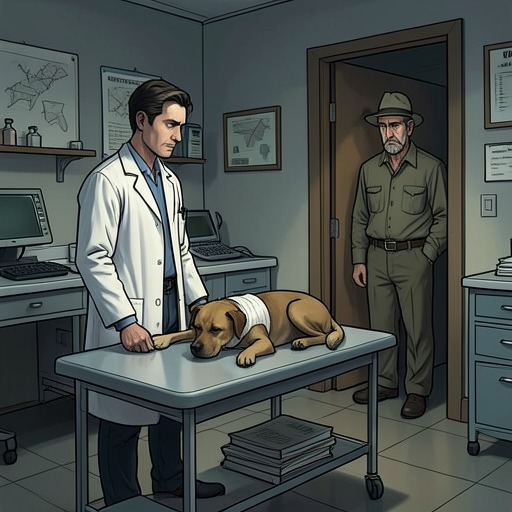
The episode begins with a professional errand from Siegfried Farnon. An elderly border terrier is on the operating table, and Siegfried asks James to take him to Angus Grier, the veterinarian who had treated the dog before its owner moved into the practice’s district. The terrier has bladder stones and needs an immediate operation. Siegfried has examined him but decides that Grier should perform it: Grier is touchy about a case he has already handled, and Siegfried does not want to offend him by taking over. James is to watch the operation and bring the dog back afterward, while being careful not to rub Grier the wrong way.
Siegfried’s warning gives the farm scene its social context. He describes Grier as a cantankerous Aberdonian whose fashionable-town practice attracts students, whom he treats harshly; the reputation, Siegfried remarks, has travelled. Grier’s first appearance reinforces that account. He greets James with little more than a nod and a grunt, then introduces Clinton, a final-year student, by disparaging his appearance and making a coarse remark about the profession. The encounter establishes a man who seems more inclined to insult than to welcome a visiting colleague.
The Unexpected Invitation
At a farm, James’s attempt to clarify what Grier expects of him goes badly. Cleansing a cow—removing retained afterbirth—is ordinarily a one-person job, and James points out that his Wellington boots and coat are back in the car. He had not realised the visit would involve farm work and does not want to get dirty unnecessarily. Grier flushes, gives him a malevolent look, and turns away. Then, halfway across the yard, he stops, thinks, and returns with an offer: James can put on something Grier has brought and come inside to pass him a pessary when needed.
The proposal sounds peculiar to James, but he follows Grier to the car rather than risk offending him again. Grier fishes a large wooden box from the boot and presents the outfit as something he acquired some time earlier. He says he has scarcely used it because it is heavy, but claims it will keep James clean. Inside is a thick, shining black rubber suit. Its jacket bristles with zips and press studs; the heavy trousers are crowded with clips and fasteners. The construction is so cumbersome that its wearer will be nearly unable to move. Its elaborate, armoured appearance promises a task far more dramatic than the assistance Grier has actually requested.
A Small Task Made into a Spectacle
Putting on the outfit requires help. James has to roll his sleeves up to his shoulders while Grier strains him into the suit, closing the high, stiff collar with a zip at the back of his neck. The collar forces his chin upward. Grier adds a black rubber skull cap despite James’s attempts to object, insisting that the job should be done properly. When Grier steps back, James is covered in gleaming black rubber, with bare arms sticking almost at right angles. He follows Grier toward the byre in ponderous, mechanical steps.
The spectators’ response turns the awkward dressing into public theatre. The farmer, two cowmen, and a little girl are present. The men’s cheerful greeting dies away as the strange, rigid figure enters, and the girl runs outside in tears. The work itself remains ordinary: Grier performs the cleansing, while James stands against the wall, sweating inside the suit. The men, unable to see what Grier is doing, watch James instead, studying every part of his costume and evidently expecting its wearer to undertake some extraordinary operation. The tight collar presses against his throat and keeps him out of the conversation, adding to the air of mystery.
When Grier finally calls him over, the men straighten and stare. James has only to fetch a pessary from a nearby tin and hand it to Grier. Yet even that small errand becomes a laborious performance. He struggles to turn, advances with his head raised and arms extended, finds that he cannot bend to reach the tin, and contorts himself until he can take out the pessary. He must remove its paper with one hand, turn carefully, and extend his arm stiffly toward Grier, who inserts it into the cow. The men observe in fascinated silence. The outfit has made a simple handover look like the climax of a mysterious and difficult procedure.
The Reveal and Its Comic Reversal
The disguise’s effect collapses when Grier finishes and begins undoing the studs and zips. The men’s expressions change from expectation to disbelief: James has worn this unwieldy armour merely to pass a pessary. Their disappointment gives way to amusement. James rubs life back into arms swollen by the tight elastic sleeves, gathers what remains of his dignity, and returns to the car while the grinning farm workers focus on him rather than on Grier. The comic imbalance is complete: the imposing equipment has transformed the assistant, not the medical task.
Back at the surgery, the border terrier is coming round from the anaesthetic. James wraps the dog in a blanket and prepares to leave, then notices Grier in a partly open storeroom, taking the rubber suit from its box. Grier’s body shakes and jerks; his face is contorted, and a half-stifled sound comes from him. James first watches in amazement, then recognises what the signs mean: Angus Grier is laughing. That recognition revises the impression built up by the referral, the insults, and the farm-yard performance. The story does not establish that Grier explained himself or openly admitted a plan; instead, his private laughter supplies the final evidence that the ordeal has also been his joke. The reveal makes the outfit more than an absurd piece of equipment: it is the instrument through which a seemingly humourless professional briefly turns a routine task into a spectacle, and through which James discovers an unexpected comic side to him.